
How Cancer Begins
Understanding What Happens Inside the Body
Every cancer begins with a cell that was once normal.
A Moment of Perspective
Cancer is one of the most feared words in any language.
The moment people hear it, questions often begin racing through their minds: How did this happen? Why me? What is happening inside my body? What happens next?
Those questions usually arrive long before understanding does.
Many of us know someone whose life has been affected by cancer. We hear words such as tumor, mutation, biopsy, chemotherapy, metastasis, and immunotherapy, yet few people are ever taught how those ideas fit together.
Without that foundation, cancer can seem mysterious and almost impossible to understand. Fear begins filling the spaces where clear explanations should have been.
This series of articles was written to help fill those spaces—not by asking you to memorize complicated terminology or overwhelming you with molecular biology, but by helping you understand what is happening, why it matters, and how the pieces connect.
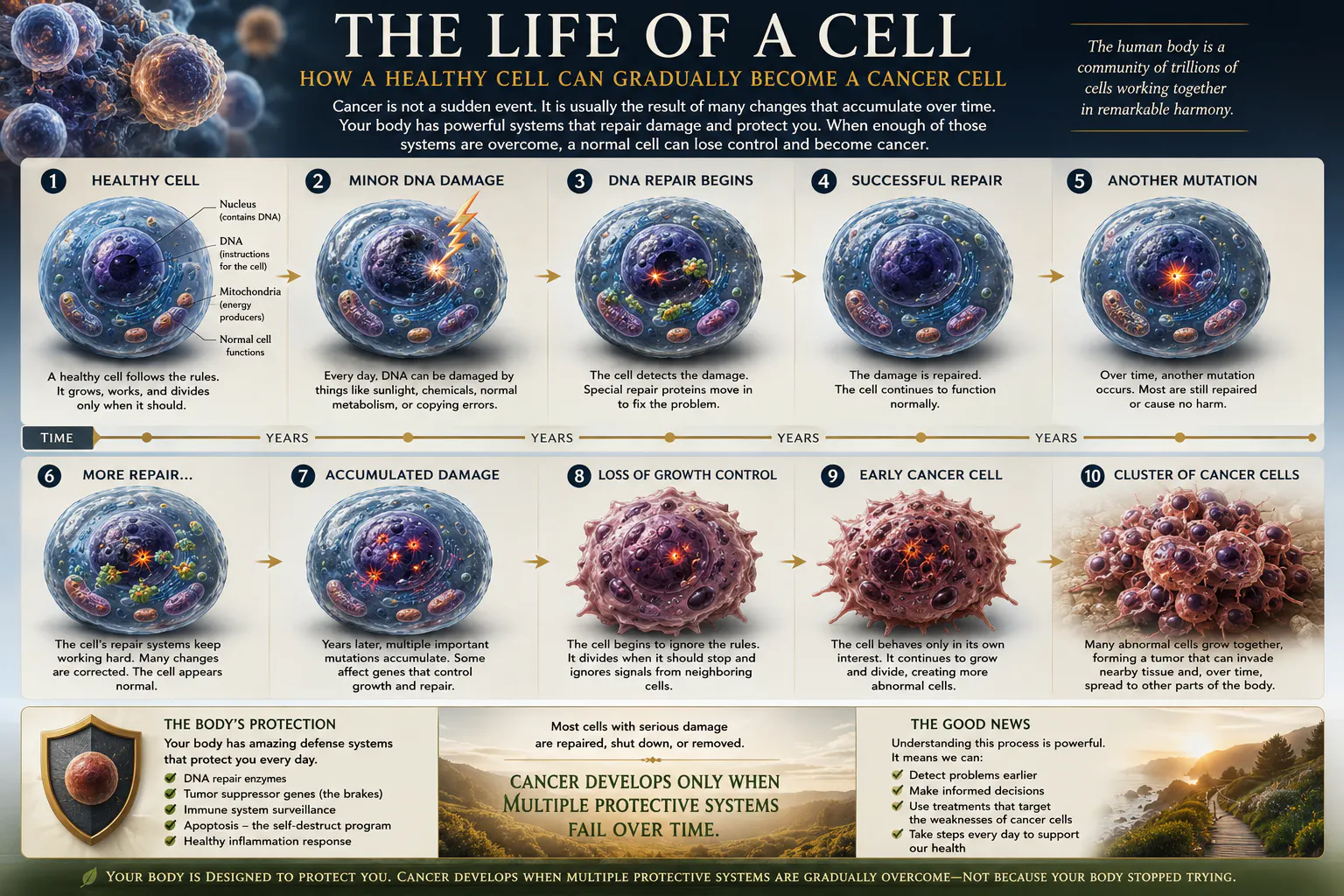
One of the most common misconceptions about cancer is that it suddenly appears without warning. In reality, most cancers develop gradually through a series of changes occurring within a single cell and its descendants.1
During that time, your body is not standing by helplessly. It is detecting damage, correcting mistakes, stopping unsafe cells from dividing, removing cells that can no longer be repaired, and calling upon the immune system when something appears abnormal.
These defenses succeed far more often than they fail.
To understand cancer, therefore, we should not begin with disease. We should begin with something far more remarkable: the extraordinary organization of a healthy human body.
Cancer is not the story of a body that lacks intelligence or defenses. It is the story of what can happen when one small part of an exceptionally well-regulated system gradually stops obeying the rules that make healthy life possible.
Before we explore how that happens, let us begin with something even more remarkable than cancer itself. Let us begin with you.
Every Cancer Begins with a Healthy Cell
Every day, without asking for your attention, your body performs an astonishing number of tasks.
As you read this page, your heart is pumping blood through an immense network of vessels. Your lungs are exchanging oxygen and carbon dioxide. Your kidneys are filtering the bloodstream. Your liver is processing nutrients, storing energy, producing essential substances, and helping remove waste.
Your nervous system is transmitting electrical and chemical messages that allow you to think, move, remember, and respond to the world around you. Your digestive system is breaking down food and interacting with a vast community of microorganisms living within your intestinal tract. Your skin is replacing worn-out cells. Your bones are continually remodeling themselves. Your muscles are repairing microscopic damage caused by ordinary movement. Your immune system is patrolling for infection, injury, and cells that no longer appear normal.
All of this is happening while you simply sit and read.
Most of us rarely think about these processes because they occur so reliably. Yet every heartbeat, thought, breath, and movement depends upon the coordinated activity of microscopic living units called cells.
Cells are so small that most cannot be seen without a microscope. Together, however, they perform one of nature’s most extraordinary accomplishments: they create you.
A Universe Beneath Your Skin
The adult human body contains on the order of thirty trillion cells, with estimates varying by body size, sex, age, and the method used to count them.2,3
To appreciate the scale of that number, imagine counting one cell every second without sleeping or stopping. It would take hundreds of thousands of years to count them all.
Each of these cells is alive. Each receives information. Each responds to its surroundings. Each performs specialized tasks. Each contributes to the health of the whole.
Nearly every cell contains essentially the same genetic instruction manual, yet different cells use different portions of those instructions.
A heart muscle cell knows how to contract. A nerve cell transmits electrical signals. A liver cell processes nutrients and chemicals. A white blood cell searches for danger. A skin cell contributes to the protective barrier between your body and the outside world.
It is as though every cell owns the same enormous library but opens only the books needed for its particular job.
This specialization allows the body to function with breathtaking precision. The process requires no conscious direction from you. You do not need to remind your heart cells to contract, instruct your immune cells to patrol, or tell your intestinal lining to renew itself.
For most of our lives, this immense cellular community works so well that we barely notice it.
The Rules That Make Life Possible
Imagine an orchestra preparing to perform a symphony.
Every musician may be highly skilled, but talent alone cannot produce music. If each person played independently, ignoring the conductor, the score, and the other musicians, the result would be noise.
Harmony requires rules. Each musician enters at the right moment. Each listens. Each pauses when necessary. Each plays a distinct part while remaining responsive to the whole.
Healthy cells behave in much the same way. They follow an intricate set of biological instructions governing when to grow, divide, remain inactive, repair damage, respond to neighboring cells, stop dividing, and die.1,4
That final rule often surprises people. We naturally think of cell death as harmful. In reality, the orderly removal of old, unnecessary, or damaged cells is essential to health.
Every day, tens of billions of cells are removed as part of normal tissue renewal. Others become damaged beyond repair and activate a controlled cell-death program. One important form is apoptosis, often called programmed cell death.5
Apoptosis is not a failure. It is protection. The body would rather sacrifice one damaged cell than allow that cell to multiply and endanger the surrounding tissue.4
Life depends not only on creating new cells. It also depends on knowing when an individual cell should step aside for the good of the whole.
Cancer begins when cells gradually lose respect for these boundaries.
Your DNA: The Instruction Manual for Life
Inside nearly every cell is a molecule called DNA.
DNA contains the biological instructions that guide a cell’s structure, behavior, and function. It tells cells which proteins to produce, how to respond to signals, when to divide, and how to carry out their specialized responsibilities.
If the DNA within a single human cell were stretched from end to end, it would measure about six feet. Yet it is carefully folded and packaged inside a nucleus too small to see without a microscope.6
Every time a cell divides, it must copy this enormous instruction manual so that each new cell receives a complete set.
Imagine reproducing a library containing billions of letters, punctuation marks, and instructions. Now imagine making those copies repeatedly throughout a lifetime with extraordinary accuracy.
That is what your cells do. The copying process is remarkably reliable, but it is not perfect. Occasionally, an error occurs.
Scientists call a lasting change in DNA a mutation. The word can sound alarming, but mutations are a normal part of biology. They occur for many reasons and do not automatically lead to cancer.1
Some arise during ordinary cell division. Others may be associated with inherited variants, tobacco smoke, ultraviolet radiation, certain infections, environmental exposures, chronic inflammation, or the by-products of normal metabolism.1,7
Most mutations are harmless. Some occur in DNA that does not influence growth or survival. Others are corrected. Still others affect cells that never become cancerous.1
Only a small fraction of mutations affect biological controls in combinations that contribute to cancer development.1,4
The Body’s Proofreaders
Your cells do not simply copy DNA and hope for the best. They proofread it.
A sophisticated network of enzymes and proteins continually examines DNA for errors and damage.8
Imagine preparing a large manuscript for publication. One editor checks spelling. Another verifies facts. Another examines formatting. Another searches for missing pages. A final reviewer decides whether the manuscript is ready to print.
Cells use multiple systems in much the same way. Some proteins detect damaged DNA. Others remove the damaged section. Still others rebuild the missing sequence. Additional checkpoints determine whether a cell should be allowed to continue dividing.8
When damage can be repaired, the cell may return to normal activity. When repair is uncertain, the cell may stop dividing. When damage is severe, the cell may activate a regulated cell-death pathway.4,8
These safeguards help explain why most DNA damage never becomes cancer. The surprising fact is not that cellular mistakes happen. The surprising fact is how frequently the body corrects them without our ever knowing.
When the Rules Begin to Break
Cancer usually does not begin with one dramatic mutation. It develops through a process.1,4
A single change may give a cell a small survival advantage. A later change may allow it to divide more readily. Another may reduce its sensitivity to stop signals. Additional changes may help it survive stress, avoid regulated cell death, or escape immune recognition.4,9
Each step alone may be insufficient. Together, however, they can gradually transform cellular behavior.
Think of a recipe. If one letter is changed, the recipe may still be understandable. Even several errors may not affect the final dish. But when enough important words are altered, the instructions no longer produce what the author intended.
Cells face a similar problem. Normal tissues can contain mutations without becoming cancerous. Cancer generally emerges only after crucial control systems have been disrupted in a combination that permits abnormal cells to survive and multiply.10
This is one reason cancer becomes more common with age. Time creates more opportunities for cells to divide, encounter damage, make copying errors, and accumulate biological changes.7,10
Aging does not guarantee cancer. It simply lengthens the period during which important changes may arise.
The Accelerator and the Brakes
To understand cancer growth, it helps to imagine two families of genes controlling a car.
The first family functions like the accelerator. These genes encourage growth and division when the body needs new cells. They help children develop, wounds heal, blood cells renew, and damaged tissues recover.
When certain growth-promoting genes become abnormally activated, they can function like an accelerator stuck to the floor. These altered genes are called oncogenes.1
The second family functions like the brakes. These genes slow cell division, detect damage, coordinate repair, and prevent unsafe cells from reproducing. They are called tumor-suppressor genes.1
Healthy growth requires both systems. The accelerator must work. The brakes must work. The cell must also respond to changing conditions.
Cancer can develop when growth signals remain active while protective braking systems become weakened or lost.1,4
The cell begins dividing when it should wait. It ignores messages telling it to stop. It survives under conditions that should trigger repair or death. It gradually behaves less like a responsible member of the body and more like an independent population concerned primarily with its own continuation.
Cancer Is an Evolution, Not an Event
One of the most important ideas in this book is that cancer is rarely a single event. It is an evolving process.9,10
A healthy cell does not suddenly awaken as a fully formed cancer cell. Instead, change accumulates. One safeguard is weakened. A later mutation provides a growth advantage. The cell’s descendants inherit those changes and may acquire additional ones.9,10
Some abnormal cells disappear. Others remain quiet. A few may develop combinations of traits that allow them to survive, reproduce, and establish a growing population.9
In this sense, cancer undergoes a form of evolution inside the body. Cells that adapt successfully survive and reproduce. Cells that cannot tolerate their environment disappear. Over time, the surviving population may become increasingly capable of resisting the conditions that once kept it under control.9,10
This helps explain why cancer can change during its course and why different areas of the same tumor may not be genetically identical.10,11
A tumor is not always a uniform mass of interchangeable cells. It can contain multiple cellular populations, each carrying somewhat different characteristics.10,11
This biological diversity is one reason cancer can be difficult to treat.10,11
Why Doesn’t the Body Always Stop Cancer?
By now, you may be wondering: if the body possesses so many protective systems, why does cancer ever develop?
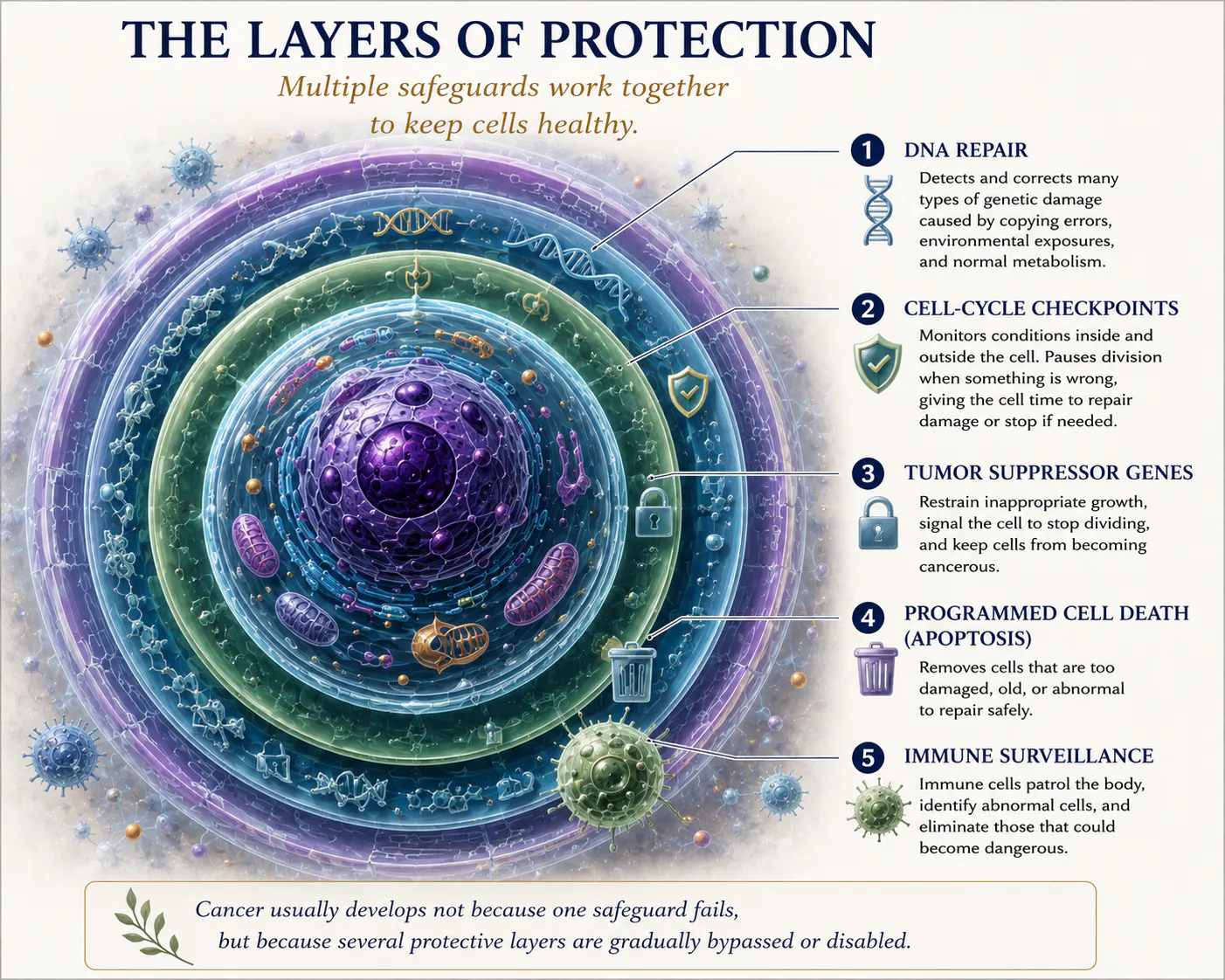
The answer is that no protective system is perfect. More importantly, cancer generally appears only after several safeguards have been overcome.4
Imagine a museum protecting a priceless artifact. The building does not rely on one lock. It uses locked doors, guards, cameras, motion sensors, alarms, reinforced glass, and controlled access. If one layer fails, others remain.
Your body uses the same general strategy. DNA repair corrects many errors. Cell-cycle checkpoints delay unsafe division. Tumor suppressors restrain inappropriate growth. Regulated cell death removes cells that cannot be safely repaired. The immune system monitors tissues for signs of danger.1,4,8,12
Cancer usually develops only after enough of these protections are bypassed.4
That is not evidence that the body stopped trying. It is evidence that the abnormal cell and its descendants gradually acquired ways to survive despite the protections surrounding them.
The Immune System: Your Silent Guardian
The immune system is best known for defending the body from infection, but its responsibilities extend beyond bacteria and viruses.
Immune cells also monitor tissues for signs of injury and abnormal behavior.12
Some transformed cells display unusual proteins or stress signals. Under favorable conditions, immune cells can recognize and eliminate such cells before they become clinically apparent.12,13
This broad concept is often described as immune surveillance and, more fully, cancer immunoediting.12,13
The immune system must perform a difficult balancing act. It must respond strongly enough to danger while avoiding unnecessary injury to healthy tissue.
That balance is essential. An immune system that attacks too little may allow danger to persist. An immune system that attacks indiscriminately can damage the body it is meant to protect.
Cancer develops within this complex biological relationship.
Cancer Learns to Hide
If immune cells can recognize abnormal cells, why do they not eliminate every cancer?
Because cancer cells can adapt.12,13
Some become less visible to immune surveillance. Some produce signals that suppress immune activity. Others recruit nearby cells that help create a protective environment. A growing tumor may alter its surroundings in ways that make an effective immune response increasingly difficult.12,13,14
Imagine a wanted criminal changing appearance, disabling security cameras, bribing guards, and transforming the surrounding neighborhood into a place where law enforcement cannot operate effectively.
Cancer cells can employ biological versions of these strategies. They may reduce signals that identify them as abnormal, activate molecular checkpoints that restrain attacking immune cells, release substances that discourage immune activity, or recruit other cells that unintentionally help them survive.12,13,14
These discoveries helped lead to immunotherapies designed to restore or strengthen antitumor immune responses.15
For now, remember this: cancer may succeed not simply because the immune system is weak, but because cancer cells can gradually evolve ways to avoid, confuse, or suppress immune control.12,13
A Disease of Lost Balance
One word has appeared quietly throughout this chapter: balance.
Healthy life depends upon it.
Cells must grow, but not without restraint. They must repair damage, but recognize when repair is no longer possible. They must respond to signals, but not create signals that serve only themselves. The immune system must attack danger while protecting healthy tissue. Inflammation must help heal injury and then subside. Old cells must leave so new cells can take their place.
Cancer develops as these relationships become increasingly unbalanced.
It is not merely a disease of excessive growth. It is a disease of lost regulation.
A cancer cell grows when it should wait. It survives when it should die. It consumes resources without regard for surrounding tissue. It ignores boundaries. It changes its environment. And, in some cases, it gains the ability to travel.
Understanding cancer therefore requires more than seeing it as a lump or an invading enemy. It requires understanding how a once-cooperative cell gradually separates its interests from those of the body that created it.
Benign and Malignant
Not Every Tumor Is Cancer
The word tumor often causes immediate fear, but not every tumor is malignant.1
A tumor is an abnormal growth or mass of tissue. Some tumors are benign, meaning they do not invade nearby tissues or spread to distant organs. Others are malignant, meaning they are cancerous.1
Imagine two neighbors expanding their homes. The first builds an addition but remains within the property line. The structure may become large and could still cause problems because of its location, but it does not invade the neighboring property. That resembles a benign tumor.
The second neighbor tears down the fence, expands onto surrounding land, damages nearby structures, and ignores every boundary. That behavior more closely resembles a malignant tumor.
The difference is not simply whether the growth becomes large. The critical difference is how it behaves.
Benign tumors can sometimes cause serious problems by pressing against organs, producing hormones, obstructing passageways, or occupying limited space. A benign brain tumor, for example, may still be dangerous because the skull provides little room for expansion.1
Malignant tumors possess a different set of biological abilities. They invade neighboring tissues and may eventually enter blood vessels or lymphatic channels, allowing cancer cells to travel elsewhere.1
That ability to spread is called metastasis. We will explore metastasis in a later chapter.1
Tumors Are Living Communities
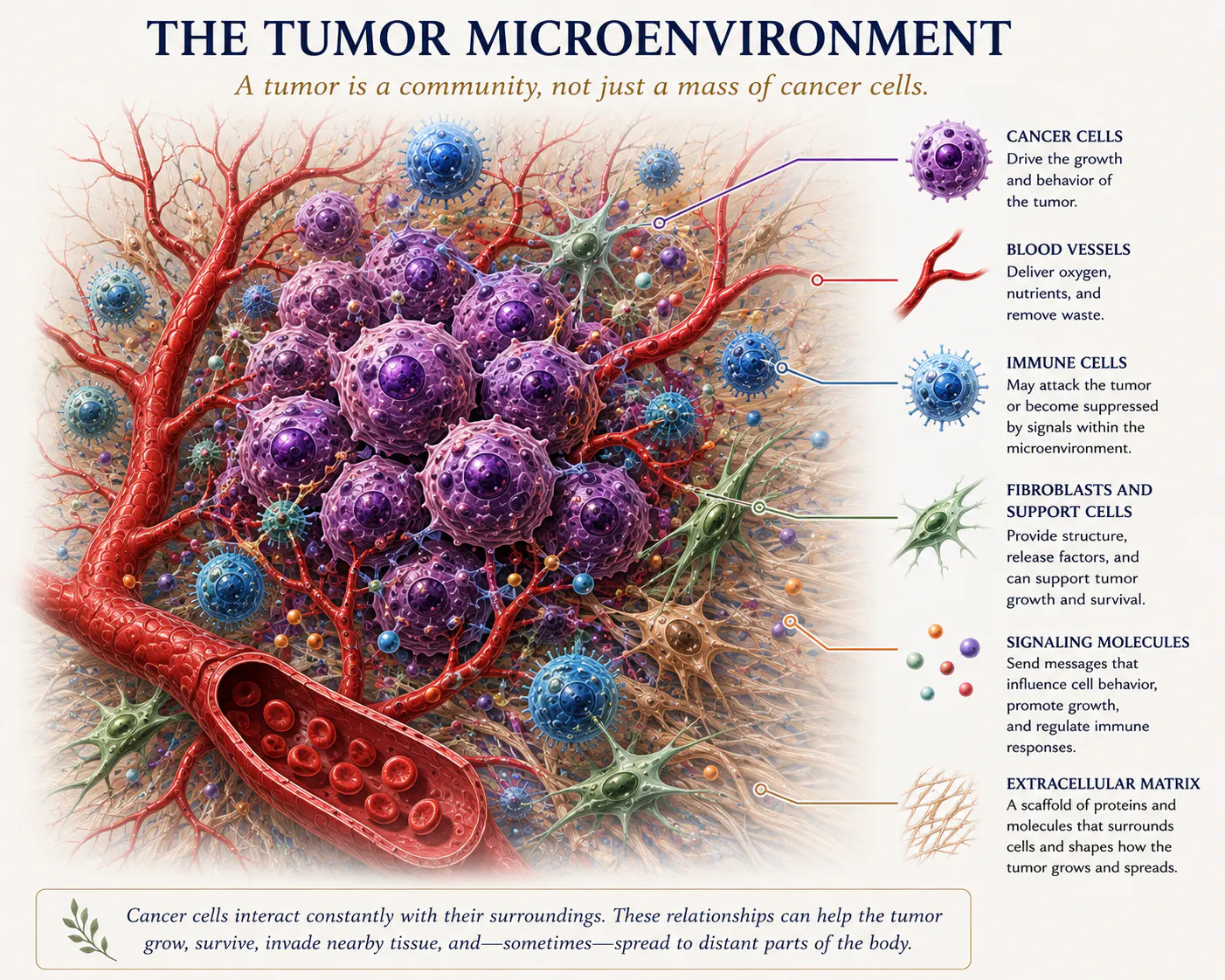
Most people imagine a tumor as a solid ball made entirely of cancer cells. The reality is more complex.
A tumor is a living community.14,16
Cancer cells interact with blood vessels, immune cells, connective tissue, structural proteins, and chemical messengers. Together, these components form the tumor microenvironment.14,16
Think of a city. A city is not composed only of residents. It also contains roads, utilities, buildings, communication systems, emergency services, businesses, and a surrounding landscape.
A tumor also depends upon its environment. Cancer cells need nutrients, communicate with neighboring cells, influence immune activity, stimulate or exploit blood vessels, and alter the tissues around them.14,16
Some surrounding cells attempt to restrain the tumor. Others may be reprogrammed or recruited in ways that support it.14,16
For many years, researchers concentrated primarily on killing cancer cells. Today, they also study the ecosystem that allows those cells to survive.14,16
A tumor does not exist in isolation. Its surroundings influence how it grows, how it responds to treatment, and whether it gains the ability to spread.14,16
Why Every Cancer Is Different
Two people may be diagnosed with cancer in the same organ and still have very different experiences.
Their tumors may grow at different rates. One may respond to a treatment that has little effect on the other. One may remain localized while another spreads. One may possess a molecular target for a particular drug while the other does not.11,17
This happens because cancer is not one disease. It is a broad family of diseases that share certain characteristics but differ biologically.1,4
Even cancers classified under the same general name can contain different mutations, proteins, hormone receptors, immune features, and patterns of gene activity.11,17
The person also matters. Age, general health, inherited genetics, previous treatments, immune function, other illnesses, and the surrounding tissue environment may influence clinical decisions and outcomes.
Modern oncology increasingly uses biomarker information to personalize treatment.17
A physician may consider where the cancer began, how it appears under a microscope, its stage and grade, which biomarkers it contains, whether it depends upon hormones, the patient’s general health and treatment goals, and how the tumor has responded to previous therapy.17,18
This is why two people with apparently similar diagnoses may receive different recommendations.
It is also why comparisons between patients can be misleading. Another person’s response does not determine yours. Your cancer has its own biology, and you have your own body, priorities, and circumstances.
Science Made Simple
Mutation, Stage, and Grade Are Not the Same
Mutation
A lasting change in DNA. Some mutations influence cancer behavior or treatment response; many do not.
Grade
A description of how abnormal the cancer cells appear and, in many cancers, how aggressively they may be expected to behave.
Stage
A description of the extent of the cancer, such as tumor size, lymph-node involvement, or spread to distant sites.
A cancer can carry important mutations regardless of its stage. Likewise, two cancers at the same stage may have different grades or molecular characteristics. Each term provides a different piece of information.17,18
Patient Voice
“I Was Bombarded with Information”
PATIENT VOICE
“I was immediately bombarded with numbers, statistics, medications and procedures.”
This experience is common after diagnosis. Medical information often arrives at the same moment a person is trying to absorb fear, uncertainty, and major life decisions.
Understanding does not require learning everything at once. Begin with a few foundational questions: What type of cancer is it? Where did it begin? How far has it spread? What biological features influence treatment? What is the goal of the recommended therapy?
Clarity can be built one answer at a time.
Myth vs. Fact
MYTH Cancer appears suddenly.
FACT Most cancers develop gradually through biological changes that accumulate over time. The diagnosis may feel sudden, but the underlying process often began much earlier.
MYTH Every mutation causes cancer.
FACT Mutations occur throughout life. Most are harmless, repaired, or found in cells that never become cancerous.
MYTH A tumor automatically means cancer.
FACT Tumors may be benign or malignant. Their behavior, location, pathology, and other features determine their significance.
MYTH The immune system failed completely if cancer developed.
FACT The immune system can suppress abnormal cells, but cancers that become clinically apparent may have evolved mechanisms of immune escape or suppression.
MYTH Everyone with the same cancer has the same disease.
FACT Cancers arising in the same organ may differ substantially in their genetics, growth patterns, treatment sensitivities, and interactions with the immune system.
MYTH Cancer is caused by one mistake or one bad decision.
FACT Cancer usually reflects a complex interaction among biology, aging, inherited susceptibility, environmental exposures, infections, lifestyle factors, inflammation, and chance. Rarely can it be reduced to one simple cause.
If You Remember Only Five Things
Every cancer begins with a cell that was once normal.
Cancer develops from the body’s own cells after biological controls governing growth, repair, and survival become disrupted.
Your body is constantly protecting you.
DNA repair, growth checkpoints, regulated cell death, immune surveillance, and other safeguards prevent countless cellular problems from progressing.
Cancer is usually a process, not a single event.
Multiple changes generally accumulate over time before a cell acquires the characteristics needed to form a malignant tumor.
A tumor is more than a lump of cancer cells.
It is a living ecosystem containing blood vessels, immune cells, connective tissue, signaling molecules, and other components that influence its behavior.
Every cancer—and every person—is different.
The location of the tumor is only part of the story. Molecular characteristics, stage, grade, general health, treatment goals, and personal values all matter.
Your body did not simply stand by. Long before a tumor could be detected, multiple systems were working to repair damage, restrain unsafe growth, remove damaged cells, and monitor tissues for danger.
Cancer developed only after a particular cell and its descendants gradually acquired enough changes to bypass several of these protections.
This distinction matters. It replaces the image of a helpless body with a more accurate one: a body that has been defending, repairing, adapting, and maintaining balance throughout your life.
Cancer is serious, but it is not mysterious magic. It is biology.
And biology can be studied. It can be measured. It can be influenced. Some cancers can be prevented, detected early, controlled for long periods, or successfully treated.
The more clearly we understand the process, the better prepared we become to understand the choices that follow.
Looking Ahead
Why Do Some People Develop Cancer While Others Do Not?
Now that we understand how one healthy cell can gradually become cancerous, another question naturally follows: Why does this process lead to cancer in one person but not another?
Why can someone appear to do everything “right” and still develop the disease, while another person with several known risk factors never does?
The answer is not found in one food, one stressful event, one exposure, one inherited gene, or one personal decision.
Cancer usually develops through a complex interaction of biology, aging, environment, immunity, lifestyle, inherited susceptibility, and chance.7
In the next articles, we will explore those influences—and why understanding them should replace blame with perspective.
Scientific References
1. National Cancer Institute. What Is Cancer? Updated October 11, 2021. Accessed August 3, 2026.
2. Sender R, Fuchs S, Milo R. Revised Estimates for the Number of Human and Bacteria Cells in the Body. PLoS Biol. 2016;14(8):e1002533. doi:10.1371/journal.pbio.1002533.
3. Hatton IA, Galbraith ED, Merleau NSC, et al. The human cell count and size distribution. Proc Natl Acad Sci U S A. 2023;120(39):e2303077120. doi:10.1073/pnas.2303077120.
4. Hanahan D. Hallmarks of Cancer: New Dimensions. Cancer Discov. 2022;12(1):31-46. doi:10.1158/2159-8290.CD-21-1059.
5. Amarante-Mendes GP, Green DR. The regulation of apoptotic cell death. Braz J Med Biol Res. 1999;32(9):1053-1061; see also estimates summarized in Cell Death and the Well of the Organism. Cell Death Discov. 2024.
6. National Human Genome Research Institute. Introduction to Genomics; Chromosomes Fact Sheet. Accessed August 3, 2026.
7. Wild CP, Weiderpass E, Stewart BW, eds. World Cancer Report: Cancer Research for Cancer Prevention. International Agency for Research on Cancer; 2020.
8. Jackson SP, Bartek J. The DNA-damage response in human biology and disease. Nature. 2009;461:1071-1078. doi:10.1038/nature08467.
9. Nowell PC. The clonal evolution of tumor cell populations. Science. 1976;194(4260):23-28. doi:10.1126/science.959840.
10. Greaves M, Maley CC. Clonal evolution in cancer. Nature. 2012;481:306-313. doi:10.1038/nature10762.
11. McGranahan N, Swanton C. Biological and Therapeutic Impact of Intratumor Heterogeneity in Cancer Evolution. Cancer Cell. 2015;27(1):15-26. doi:10.1016/j.ccell.2014.12.001.
12. Schreiber RD, Old LJ, Smyth MJ. Cancer immunoediting: integrating immunity’s roles in cancer suppression and promotion. Science. 2011;331(6024):1565-1570. doi:10.1126/science.1203486.
13. Teng MWL, Galon J, Fridman WH, Smyth MJ. From mice to humans: developments in cancer immunoediting. J Clin Invest. 2015;125(9):3338-3346. doi:10.1172/JCI80004.
14. Hanahan D, Coussens LM. Accessories to the crime: functions of cells recruited to the tumor microenvironment. Cancer Cell. 2012;21(3):309-322. doi:10.1016/j.ccr.2012.02.022.
15. National Cancer Institute. Immunotherapy to Treat Cancer. Accessed August 3, 2026.
16. de Visser KE, Joyce JA. The evolving tumor microenvironment: From cancer initiation to metastatic outgrowth. Cancer Cell. 2023;41(3):374-403. doi:10.1016/j.ccell.2023.02.016.
17. National Cancer Institute. Biomarker Testing for Cancer Treatment. Updated December 14, 2021. Accessed August 3, 2026.
18. National Cancer Institute. Diagnosis and Staging; Tumor Grade. Accessed August 3, 2026.