
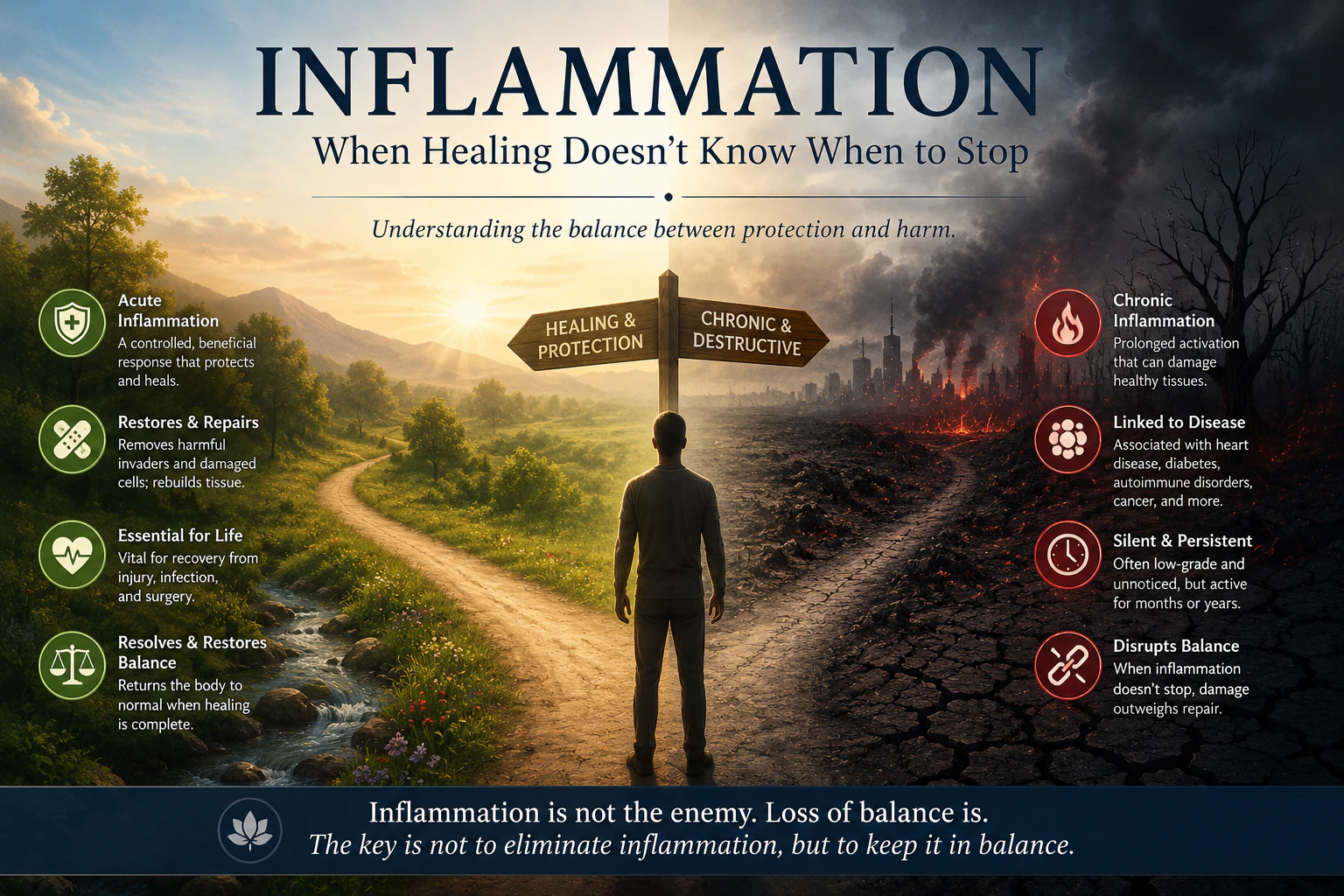
Every day your body performs one of the most extraordinary balancing acts in biology—protecting you while avoiding unnecessary harm.
What This Article Will Help You Understand
Few words in medicine have become as misunderstood as inflammation.
Mention the word, and most people immediately think of pain, swelling, arthritis, or disease. Television commercials encourage us to reduce it. Magazine articles warn about it. Health websites describe it as the hidden cause of countless illnesses. Before long, it becomes easy to think of inflammation as something the body should avoid altogether.
Nothing could be further from the truth.
Long before there were hospitals, medications, or surgeons, inflammation was already protecting life. It is one of the oldest biological defense systems on Earth—a response so fundamental that versions of it can be found throughout the animal kingdom. Every scrape, every bruise, every infection, every broken bone, and every surgical incision depends upon inflammation to begin the remarkable process of healing.
Without it, even a minor cut could become life-threatening.
The warmth you feel around an injury...
The redness surrounding a healing wound...
The swelling after twisting an ankle...
These are often not signs that your body is failing.
They are signs that it has already begun repairing itself.
Like so many extraordinary systems within the human body, however, inflammation depends upon one essential principle.
Balance.
When inflammation begins at the right moment, performs the work it was designed to do, and then quietly resolves, it becomes one of your greatest allies.
When it continues beyond its intended purpose, the same biological response that once protected you may gradually begin damaging healthy tissues. Over months or years, persistent inflammation has been associated with many chronic illnesses, including cardiovascular disease, diabetes, autoimmune disorders, neurodegenerative diseases, and several forms of cancer.
Notice something important.
Inflammation itself is not the enemy.
Loss of balance is.
That distinction changes everything.
Throughout this article, we'll explore one of the body's most remarkable healing systems—not simply to understand inflammation, but to better appreciate the extraordinary intelligence with which the human body protects itself every day.
By the time you finish this article, I hope you'll no longer think of inflammation as something that is either "good" or "bad." Instead, I hope you'll recognize it for what it truly is:
A carefully orchestrated healing response whose greatest strength lies not only in knowing when to begin...
but in knowing when its work is complete.
A Question Worth Carrying
Before we begin, I'd like you to consider one simple question.
What would happen if your body completely lost the ability to create inflammation?
Imagine cutting your finger while preparing dinner. Imagine developing pneumonia. Imagine breaking a bone. Imagine undergoing surgery. How would any of those injuries heal if your body could never summon blood, immune cells, nutrients, and repair mechanisms to the site of damage?
The answer is surprisingly sobering. They wouldn't. The absence of inflammation would not produce perfect health. It would make healing nearly impossible. Keep that thought with you as we continue. By the end of this article, I believe you'll see inflammation very differently.
Opening Narrative
Picture an ordinary evening.
You're standing in your kitchen preparing dinner. Sunlight filters through the window as you slice vegetables for a salad. The radio plays quietly in the background. It's a routine you've performed hundreds of times.
Then, in a brief moment of distraction, the knife slips. You feel a sharp sting. A thin line appears across your fingertip. A single drop of blood begins to form. For a few seconds, the injury seems almost insignificant. You rinse the cut under cool water, reach for a bandage, and return to preparing dinner.
From your perspective, almost nothing has happened. From your body's perspective...everything has happened. Long before your conscious mind has fully processed the injury, millions of cells have already recognized that something is wrong. Damaged cells release tiny chemical distress signals. Nearby blood vessels respond almost immediately, widening ever so slightly to increase blood flow to the area. Platelets begin gathering to help seal the wound. Proteins already circulating in your bloodstream activate one another like falling dominoes, preparing to control bleeding and defend against infection.
Within minutes, specialized white blood cells begin leaving the bloodstream and moving toward the injured tissue. Some will destroy invading bacteria. Others will remove damaged cells. Still others will coordinate the repair process that is already beginning.
No one tells them where to go. There is no conscious command. No emergency broadcast. No central dispatcher. Each cell responds because it has spent millions of years evolving to recognize exactly this kind of moment.
What appears to be a tiny cut has quietly activated one of the most sophisticated biological responses found anywhere in nature. That response is inflammation. The remarkable thing is not that inflammation occurs. The remarkable thing is how precisely it is controlled.
Every participant has a role. Every signal has a purpose. Every stage prepares the next.
When everything unfolds as it should, the wound heals, the inflammation gradually subsides, and within days you may struggle to remember exactly where you were injured. The body's goal was never inflammation. Its goal was restoration. Inflammation was simply the path that made restoration possible.
What You're Looking At
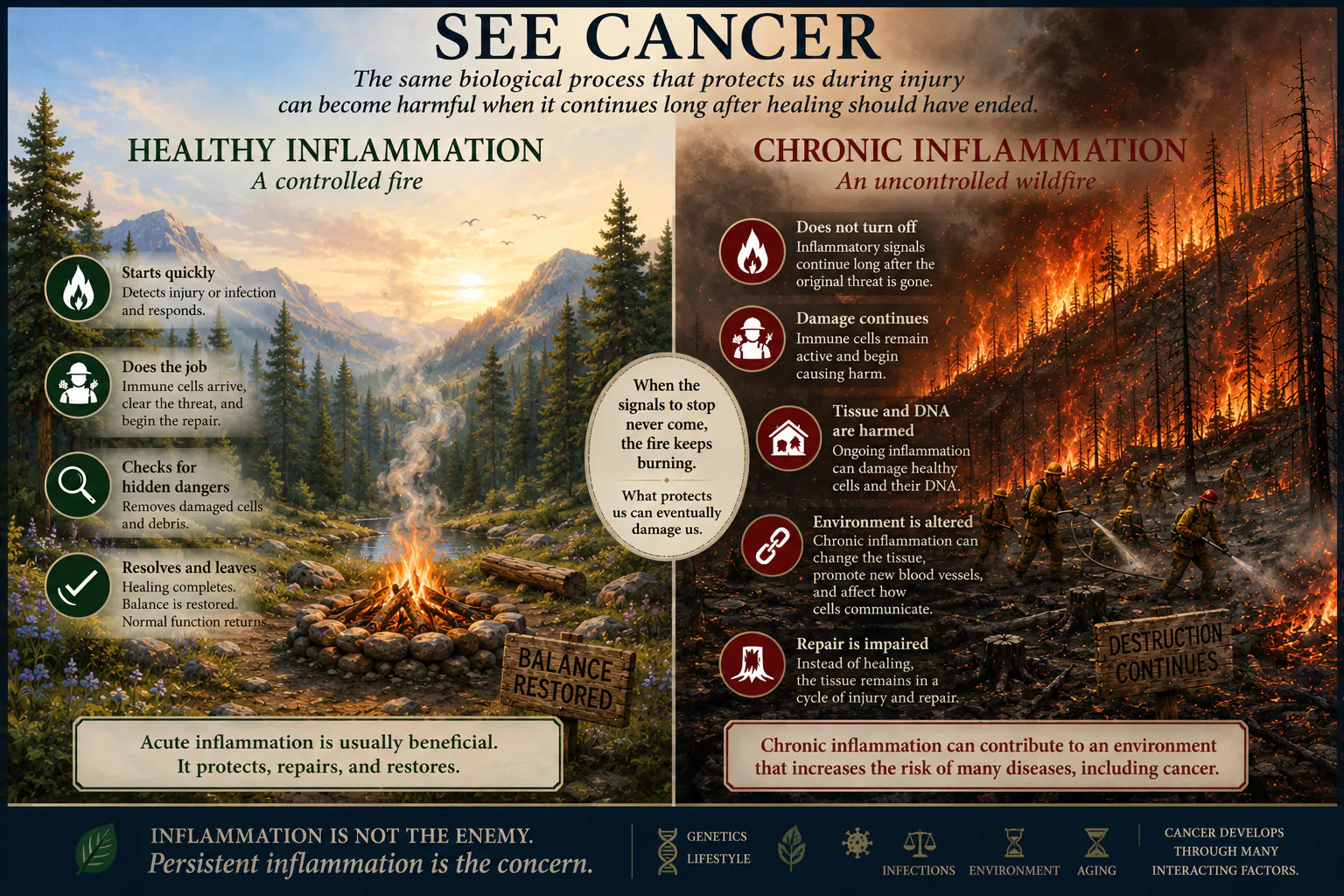
Why a campfire? Because few images capture the nature of inflammation more elegantly. Think about everything a well-managed campfire provides. It gives warmth on a cool evening. It allows food to be prepared. It creates light in darkness. It gathers people together.
Under the right conditions, fire becomes one of humanity's oldest and most valuable tools. Yet no one leaves a campfire unattended. When the evening ends, someone pours water over the embers. Someone stirs the ashes. Someone confirms that every spark has disappeared before walking away. Not because fire is inherently dangerous. But because even something profoundly beneficial can become destructive when it burns beyond its intended purpose.
Inflammation follows the same principle. After an injury, your body intentionally lights a small biological fire. Blood flow increases. Immune cells arrive. Damaged tissue is removed. Repair begins.
Everything about this response has a purpose. When the work is complete, however, the body must do something equally important. It must extinguish the fire. The healthiest inflammatory response is not the strongest. It is the one that knows exactly when its work is finished. That simple idea will guide everything else you read in this article.
The Body's Fire
If the campfire teaches us whyinflammation exists, the next question naturally follows. How does the body actually create this remarkable healing response? The answer is both elegant and surprisingly beautiful.
Imagine standing at the edge of a quiet lake early in the morning. The water is perfectly still. Then a single pebble falls into the center. Almost instantly, ripples begin spreading in every direction. Each wave reaches places far beyond the point where the pebble first entered the water.
An injury behaves much the same way. Whether the damage is caused by a splinter, a virus, a surgical incision, or a twisted ankle, the first injured cells immediately send out tiny chemical signals announcing that something has changed.
These signals spread through the surrounding tissue like ripples across water. Nearby cells recognize the message. Blood vessels respond. Immune cells begin changing direction. Repair mechanisms awaken.
What started as the injury of only a handful of cells quickly becomes a coordinated response involving thousands—and sometimes millions—of others.
Remarkably, no single cell understands the entire process. Each one simply performs its own role. Yet together they create one of the most sophisticated healing systems in biology. Nature accomplishes extraordinary things through countless small acts working together. The human body is no exception.
Healing Is Not One Event
Most of us imagine healing as something that simply happens. A cut heals. A bruise disappears. A broken bone mends. Because we cannot see what is occurring beneath the skin, the process feels almost automatic.
In reality, healing unfolds through an extraordinarily organized sequence of events. Each stage prepares the next. Each stage depends upon the one before it. Interrupt one step, and every step that follows becomes more difficult.
Modern biology often divides this process into four overlapping phases. Although scientists continue discovering new details, the overall pattern remains remarkably consistent. The body first recognizes the injury. Then it protects. Then it rebuilds. Finally, it restores balance.
Healing, therefore, is not a single event. It is a carefully choreographed journey.
Stage One
Recognizing That Something Is Wrong
Every healing story begins with recognition. Before the body can repair an injury, it must first realize that one has occurred. Damaged cells accomplish this by releasing tiny molecules that function much like distress beacons.
Scientists sometimes refer to these as danger signals because they alert neighboring cells that tissue has been injured. Within moments, nearby blood vessels respond. Their walls relax slightly. More blood begins flowing toward the area. This increased circulation explains why injured tissues often become warm and red.
Far from representing failure, these changes reflect one of the body's first acts of protection. Additional oxygen arrives. More nutrients become available. Specialized proteins and immune cells gain easier access to the damaged tissue. The body is preparing the worksite before reconstruction begins.
At the same time, nerve endings become more sensitive. This increased sensitivity produces discomfort. Although pain is never pleasant, it serves an important purpose. Pain reminds us to protect the injured area while healing is underway. Without pain, we might continue walking on a broken ankle or repeatedly reopen a healing wound. Even discomfort has purpose.
Stage Two
The First Responders
As blood flow increases, another remarkable event begins. Specialized white blood cells leave the bloodstream and enter the damaged tissue. Among the first to arrive are neutrophils. Think of them as the emergency responders of the immune system. Their job is immediate. They destroy invading bacteria. They remove damaged tissue. They help prevent infection while the body organizes a more complete repair. Neutrophils work quickly. Many complete their mission within hours.
Soon afterward, another group of remarkable cells arrives. These are macrophages. The name comes from the Greek words meaning large eater, an appropriate description because these cells engulf bacteria, damaged cells, and other debris left behind after injury. For decades, scientists viewed macrophages primarily as the body's cleanup crew.
Today we appreciate that they are much more than that. Macrophages act as communicators. They help determine when inflammation should continue. They also help determine when it is time for healing to move into its next phase. In many ways, macrophages function like experienced foremen on a construction site. They constantly assess progress. If more cleanup is needed, they call for assistance. If the site is ready for rebuilding, they begin changing the instructions they send to surrounding cells.
Healing depends as much upon communication as it does upon action.
Stage Three
Rebuilding What Was Lost
Once immediate danger has passed, the body quietly shifts its priorities. The goal is no longer simply defending tissue. Now it begins restoring it.
Fibroblasts—specialized cells responsible for producing connective tissue—begin constructing new collagen. Tiny new blood vessels form to nourish recovering tissue. Skin cells divide. Bone cells begin rebuilding microscopic fractures. Muscle fibers repair themselves. The body starts replacing what injury has taken away.
One of the most extraordinary aspects of this stage is that many of the same immune cells that arrived prepared for battle now begin encouraging reconstruction instead. They have not disappeared. They have simply changed their role. The emergency response gradually becomes a rebuilding project. The body is constantly adapting to what the moment requires.
When Healing Doesn't Know When to Stop
Every Story Needs an Ending
Think back to the small cut on your finger from the beginning of this chapter. The bleeding stopped. The wound closed. New skin gradually formed. Within days, the injury was little more than a memory. Why? Because the body knew when the work was finished.
The immune cells that had rushed to defend the area quietly withdrew. Blood vessels returned to their normal size. Chemical messengers that had summoned help began sending a different message: "The danger has passed."
The biological fire that had burned so brightly during the first hours after the injury slowly faded. The tissue returned to its normal state. This final step may seem almost unremarkable. In reality, it is one of the greatest achievements in all of biology. Healing is not complete simply because new tissue has formed. Healing is complete only when the body successfully restores balance.
Without resolution, inflammation would continue indefinitely. The emergency would never end. Fortunately, in healthy tissues, it almost always does.
The Forgotten Stage of Healing
For much of modern medical history, scientists believed inflammation simply faded away once the injury had healed. Like a fire burning out after consuming its fuel, it was assumed that inflammation naturally disappeared when it was no longer needed.
Today we know something very different. Resolution is not passive. Resolution is active. The body doesn't wait for inflammation to stop. It instructs it to stop. Specialized molecules begin changing the conversation between cells. Instead of sending messages that recruit additional immune cells, new signals begin encouraging repair.
Macrophages that had spent hours clearing damaged tissue begin removing immune cells that have completed their work. Blood vessels become less permeable. Fluid leaves the tissue. Swelling gradually subsides.
The emergency response quietly transforms into restoration. This discovery changed the way scientists think about healing. Inflammation is not simply switched on. It is carefully switched off. The ability to resolve inflammation may be just as important as the ability to create it.
A Fire That Escapes the Fire Ring
Imagine once again sitting beside the peaceful campfire from earlier in the article. The evening is quiet. The flames are steady. The fire remains safely contained within its circle of stones. It provides warmth, comfort, and light. Everything is exactly as it should be.
Now imagine something changes. A strong wind begins to blow. Tiny embers lift into the air. One lands in dry grass just beyond the fire ring. Then another. Within minutes, the grass ignites. Soon, nearby shrubs begin burning. The flames spread into surrounding trees. What had been a peaceful campfire becomes something entirely different. Not because fire itself changed. Because its boundaries disappeared. Inflammation behaves much the same way.
The chemical messengers that once protected injured tissue continue signaling after the danger has passed. Immune cells remain active longer than necessary. Repair continues after repair is complete. The body is no longer responding to an emergency. It is responding to the memory of one. This is the beginning of chronic inflammation.
The Balance Scale
Imagine an old-fashioned balance scale. On one side are the signals that promote inflammation. On the other are the signals that promote healing and resolution.
When you suffer an injury, the inflammatory side naturally becomes heavier. This is appropriate. The body needs to respond.
As healing progresses, however, the opposite side gradually begins to rise. Repair becomes more important than defense. Resolution becomes stronger than inflammation. Eventually, equilibrium returns. This constant movement is one of the defining characteristics of health.
The healthiest body is not one without inflammation. It is one that knows how to restore balance.
Chronic Inflammation and Cancer
Cancer is not caused by one event. Nor is it caused by one molecule, one gene, one infection, or one inflammatory signal. It develops through a complex interaction of genetics, aging, environmental exposures, immune function, metabolism, lifestyle, and chance.
Within this larger picture, chronic inflammation has emerged as one important area of scientific investigation. Persistent inflammation may influence the environment surrounding cells in several ways. Over time, inflammatory molecules may increase oxidative stress, contribute to DNA damage, stimulate new blood vessel formation, alter immune surveillance, and encourage repeated cycles of tissue repair and cell division.
Each of these changes may increase opportunities for abnormal cells to survive and acquire additional mutations. Importantly, this does not mean inflammation inevitably causes cancer. Far from it. Many people experience chronic inflammatory conditions and never develop cancer.
Likewise, many cancers arise without obvious chronic inflammation. The relationship is one of influence rather than certainty. Understanding this distinction helps us appreciate both the complexity of cancer and the remarkable balance required to maintain health.
The campfire and the wildfire are not different because one contains fire and the other does not. They are different because one remains under careful control. Your body is constantly managing thousands of similar balancing acts. It knows when to begin. It knows when to defend. It knows when to rebuild. And, under healthy circumstances, it knows when to stop.
Everything Is Connected
One of the most remarkable discoveries in modern biology is that no system within the human body works alone.
· Inflammation communicates with the immune system.
· The immune system communicates with the nervous system.
· The nervous system communicates with the endocrine system.
· Hormones influence metabolism.
· Metabolism influences inflammation.
· Sleep affects hormone production.
· Exercise influences immune function.
· Nutrition supports every one of these systems simultaneously.
Nothing exists in isolation. The body is not a collection of separate organs performing independent tasks. It is an integrated community of living systems, each continually influencing the others. Understanding this changes how we think about health. It also changes how we think about disease.
When one system struggles, others often respond. Sometimes they compensate. Sometimes they adapt. Sometimes they call for help. The body is constantly trying to preserve balance. That effort deserves our admiration.
What This Means for You
At this point, you may be wondering what all of this means in everyday life. Perhaps the most important lesson is this: Your body is constantly working on your behalf. Every breath. Every heartbeat. Every night's sleep. Every meal. Every healing wound. Every recovered infection. Your body is continually investing energy into maintaining life. Sometimes it succeeds quietly. Sometimes it struggles. Sometimes it needs help.
The choices we make each day—how we nourish ourselves, move our bodies, sleep, manage stress, and care for our overall health—also influence the environment in which healing occurs. These ideas are not competitors. They are partners.
Questions to Ask Your Healthcare Team
Understanding inflammation allows you to participate more confidently in conversations about your health.
Here are a few questions you may find helpful:
- What type of inflammation is involved in my condition?
- Is this inflammation helping normal healing, or has it become persistent?
- What do you believe is driving the inflammatory response?
- Are there tests that help monitor inflammation in my situation?
- Which treatments are intended to reduce inflammation, and how do they work?
- Are there lifestyle changes that may help support healthy inflammatory regulation?
- How will we know whether my inflammation is improving?
Good questions create meaningful conversations. Meaningful conversations lead to better understanding. And better understanding often leads to better decisions.
One Thing I Hope You Remember
If there is one lesson I hope remains with you long after you finish this article, it is this: Your body is not designed for chaos. It is designed for healing. Inflammation is not evidence that your body has failed. More often, it is evidence that your body has recognized a problem and immediately begun working toward a solution.
Sometimes that solution becomes prolonged. Sometimes it loses its balance. Sometimes medicine is needed to help restore normal function. But the existence of inflammation itself is not the enemy. It is one of the oldest expressions of the body's commitment to preserve life.
The question is not whether the fire should exist. The question is whether the fire remains where it belongs. Once we understand that distinction, we begin seeing healing differently. And when we begin seeing healing differently...we often begin seeing ourselves differently as well.
Scientific References
General Inflammation
Medzhitov R. Origin and physiological roles of inflammation. Nature. 2008;454(7203):428-435. doi:10.1038/nature07201 A landmark review explaining why inflammation evolved and its role in normal healing.
Nathan C, Ding A. Nonresolving inflammation. Cell. 2010;140(6):871-882. doi:10.1016/j.cell.2010.02.029 Excellent discussion of why inflammation becomes chronic.
Chen L, Deng H, Cui H, et al.Inflammatory responses and inflammation-associated diseases in organs. Oncotarget. 2018;9(6):7204-7218. A broad review of inflammation throughout the body.
Acute Inflammation and Wound Healing
Eming SA, Krieg T, Davidson JM. Inflammation in wound repair: molecular and cellular mechanisms. Journal of Investigative Dermatology.
2007;127:514-525.Gurtner GC, Werner S, Barrandon Y, Longaker MT.
Gurtner GC, Werner S, Barrandon Y, Longaker MT. Wound repair and regeneration. Nature. 2008;453:314-321.
Resolution of Inflammation
Serhan CN. Pro-resolving lipid mediators are leads for resolution physiology. Nature. 2014.
Serhan CN, Savill J. Resolution of inflammation: the beginning programs the end. Nature Immunology. 2005.
Macrophages
Wynn TA, Vannella KM. Macrophages in Tissue Repair, Regeneration, and Fibrosis. Immunity. 2016.
Neutrophils
Kolaczkowska E, Kubes P. Neutrophil recruitment and function in health and inflammation. Nature Reviews Immunology. 2013.
Chronic Inflammation
Furman D, Campisi J, et al. Chronic inflammation in the etiology of disease across the life span. Nature Medicine. 2019.
Inflammation and Cancer
Hanahan D. Hallmarks of Cancer: New Dimensions. Cancer Discovery. 2022.
Greten FR, Grivennikov SI. Inflammation and Cancer: Triggers, Mechanisms and Consequences. Immunity. 2019.
Coussens LM, Werb Z. Inflammation and cancer. Nature. 2002.
Mantovani A, Allavena P, Sica A, Balkwill F. Cancer-related inflammation. Nature. 2008.
Oxidative Stress
Reuter S, Gupta SC, Chaturvedi MM, Aggarwal BB. Oxidative stress, inflammation, and cancer. Free Radical Biology & Medicine. 2010.
Angiogenesis
Carmeliet P. Angiogenesis in life, disease and medicine. Nature. 2005.
Immune Surveillance
Schreiber RD, Old LJ, Smyth MJ. Cancer immunoediting: integrating immunity's roles in cancer suppression and promotion. Science. 2011.
Systems Biology
Kitano H. Systems Biology: A Brief Overview. Science. 2002.
Immunology Textbook
Abbas AK, Lichtman AH, Pillai S. Cellular and Molecular Immunology. 11th Edition. Elsevier.
Pathology Textbook
Kumar V, Abbas AK, Aster JC. Robbins & Cotran Pathologic Basis of Disease. 11th Edition. Elsevier.