

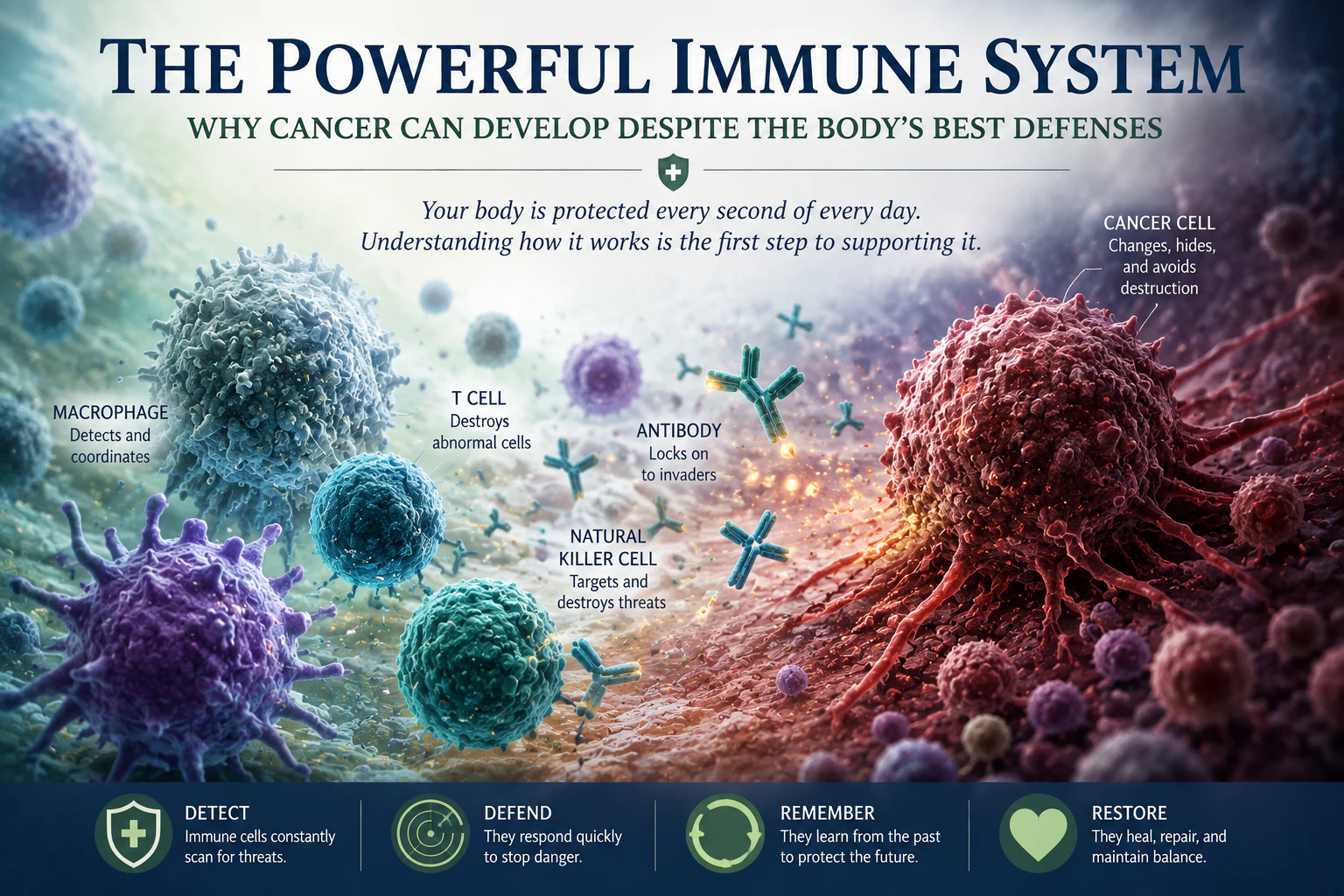
Every second of every day, your body is fighting battles you never see.
Long before you notice a sore throat, long before a cut becomes infected, and long before a cancer could ever become large enough to appear on a scan, an extraordinary army of microscopic guardians is already hard at work. They patrol your body, identify threats, communicate with one another, destroy dangerous invaders, repair damage, and remember enemies they have encountered before.
Most of their victories happen so quietly that you never know they occurred.
That is exactly how the immune system was designed to work.
Yet this remarkable reality raises one of the most common questions people ask after receiving a cancer diagnosis:
"If my immune system is so powerful, why did I get cancer?"
The answer isn't that your immune system failed. The truth is far more fascinating—and far more hopeful.
Your Body Is Protected by an Entire Community
Many people picture the immune system as if it were a single army marching into battle. Modern biology tells a much richer story.
Your immune system is actually an enormous community of specialists, each with a different assignment. Some act like police officers patrolling your neighborhoods. Others resemble firefighters rushing toward danger. Some gather intelligence. Others manufacture highly specialized weapons. A few spend years remembering previous battles so they can respond even faster the next time.
No single cell protects you.
Together, they form one of the most sophisticated defense systems ever discovered.
That cooperation is what makes the immune system so remarkable.
The First Responders
Imagine you're slicing vegetables for dinner and accidentally cut your finger. To you, it's a small injury. To your immune system, it's an emergency.
Within seconds, damaged cells begin releasing chemical distress signals. Nearby blood vessels open wider, allowing immune cells to reach the injured area. Almost immediately, the first responders arrive.
Among the earliest are cells called neutrophils. Think of them as firefighters racing toward a burning building while everyone else runs away.
They squeeze through tiny blood vessels, follow invisible chemical trails to the injury, destroy invading bacteria, and begin cleaning up damaged tissue before infection has a chance to take hold.
Without these quiet guardians, even a small cut could become life-threatening.
The Master Coordinators
Once the immediate danger is under control, another remarkable cell arrives: the macrophage. Its name literally means "large eater," because one of its jobs is consuming bacteria and damaged cells. But scientists now know macrophages are much more than biological garbage collectors.
They are decision-makers.
Imagine a construction foreman arriving after a storm. Before rebuilding begins, someone has to inspect the damage, decide what can be saved, determine what must be removed, and know exactly when reconstruction should begin.
Macrophages perform much the same role.
They continually ask:
- Is the danger gone?
- Do we need more help?
- Is it finally time to repair?
When the answers change, their behavior changes. Instead of calling for more inflammation, they begin directing healing.
One of the most beautiful lessons in biology is this: The same cells that know how to fight also know when fighting should stop.
The Immune System Learns
Some immune cells do something even more extraordinary. They remember.
Every infection you've recovered from…
Every vaccine you've received…
Every virus you've successfully defeated…
Leaves behind a biological memory.
Scientists call this the adaptive immune system.
Unlike the first responders, which react to almost any danger, adaptive immune cells learn to recognize specific enemies. If they encounter the same virus or bacteria years later, they respond much faster because they've seen it before.
Your immune system is constantly studying your past so it can better protect your future.
Precision Instead of Chaos
Another group of immune cells, called killer T cells, specialize in surgical precision. Rather than attacking everything nearby, they inspect cells one by one. If a cell displays signs of infection or abnormal behavior, the killer T cell quietly instructs it to destroy itself. Healthy neighboring cells remain untouched.
This extraordinary accuracy allows your immune system to eliminate countless dangerous cells every day while leaving healthy tissues unharmed.
Your Personal Weapons Factory
Protection also requires specialized tools. That responsibility belongs largely to B cells. When needed, B cells transform into microscopic factories that manufacture antibodies.
An antibody is like a custom-made key designed to fit only one specific lock. Once attached to bacteria, viruses, or abnormal cells, antibodies make those targets easier for the rest of the immune system to recognize and destroy.
Again, the lesson is cooperation.
No immune cell works alone.
Nature's Security Guards
Another fascinating group of defenders are natural killer (NK) cells. Unlike many immune cells that require previous experience before attacking, NK cells continuously patrol the body looking for suspicious behavior.
Think of them as experienced security guards walking through a crowded airport. They don't necessarily know every criminal by name. But they know when something looks wrong.
When they detect cells behaving abnormally—including many cells beginning the process of becoming cancer—they often destroy them before they can cause harm.
Your Immune System Stops Cancer Every Day
This surprises many people. Cancer doesn't begin as a tumor. It begins as a single abnormal cell. As billions of cells divide throughout your lifetime, mistakes occasionally occur.
Fortunately, your immune system recognizes and removes many of these abnormal cells long before they become dangerous. These invisible victories happen throughout your life. You never notice them. But they may be among your immune system's greatest achievements.
So Why Does Cancer Sometimes Win?
If the immune system is so effective, why does cancer sometimes develop? Because cancer doesn't simply grow. It evolves.
Cancer cells constantly accumulate new mutations. Most of these changes are harmful to the cancer itself, and those cells disappear. Occasionally, however, one mutation provides a small advantage. Perhaps that cell divides a little faster. Perhaps it survives a little longer. Or perhaps it becomes slightly harder for the immune system to recognize. Over time, those tiny advantages accumulate.
Cancer becomes better at surviving—not because it is stronger than the immune system, but because it gradually becomes better at hiding from it.
A Game of Hide-and-Seek
Think back to playing hide-and-seek as a child. The easiest hiding places are found first. The winners are usually the children who learn to hide differently.
Cancer behaves in a surprisingly similar way. It often survives not by overpowering the immune system but by becoming harder to see.
The better it hides…
The longer it survives.
Every Cell Carries an Identification Badge
Nearly every cell in your body displays tiny proteins on its surface that function much like identification badges. Immune cells routinely inspect these badges. Healthy cells display healthy information. Abnormal cells often display abnormal information.
That's how killer T cells know which cells require attention.
Cancer Learns to Remove Its Badge
Some cancers discover a clever trick. They reduce the number of identification molecules they display.
Imagine someone entering a secure building after removing their employee badge. Recognizing them suddenly becomes much harder.
Cancer uses the same strategy. By displaying fewer identification markers, certain cancer cells become less visible to parts of the immune system.
Fortunately, the body anticipated that possibility. Natural killer cells actually become suspicious when identification badges disappear.
Once again, the immune system relies on overlapping layers of protection.
Cancer Presses the Brakes
Cancer has another remarkable strategy. Your immune system contains natural braking systems called immune checkpoints. These brakes exist for an important reason. Without them, immune cells might attack healthy tissues and cause serious damage.
Cancer sometimes learns to exploit these safety mechanisms. Instead of fighting harder, cancer sends molecular signals that essentially tell nearby immune cells:
"Nothing to see here."
"Stand down."
Sometimes the immune cells obey. Not because they are weak. Because cancer has learned how to manipulate the body's own safety systems.
Your Immune System Never Stopped Trying
Perhaps the most important message is this: A cancer diagnosis does not mean your immune system ignored the problem.
For months—or even years—it may have been recognizing abnormal cells, destroying many of them, adapting to new mutations, and continually trying to maintain balance.
Cancer is not evidence that your body never fought. In many cases, it is evidence that the battle became extraordinarily complicated. That is a very different way of thinking about disease.
Instead of asking,
"Why did my body fail?"
we can ask,
"How can we better understand—and support—the remarkable defenses my body already possesses?"
A Different Way to See Your Body
Modern medicine continues discovering new ways to help the immune system recognize cancer, communicate more effectively, and overcome the tricks cancer uses to survive. Those discoveries are changing cancer treatment around the world.
But perhaps the most important lesson is one you can carry with you today. Your body is not passive. It is not simply waiting for disease to happen. Every moment of every day, billions of microscopic guardians are protecting you, communicating with one another, repairing damage, remembering past battles, and striving to maintain health.
Most of their work happens in complete silence. You never see it. You rarely think about it. Yet it is happening every second of your life.
Understanding that truth replaces fear with appreciation.
Your immune system is not perfect. No biological system is. But it is one of the most extraordinary protective networks ever discovered. It has been defending you since before you took your first breath, and it continues working on your behalf every moment of every day.
And that may be one of the most hopeful stories in all of biology.
Would You Like to Learn More?
Learning how the immune system protects your body is empowering. It reminds us that your body has been working on your behalf every moment of your life—even long before symptoms appear. While no therapy can guarantee a particular outcome, modern medicine continues to discover new ways to support the body's natural defenses and help patients navigate cancer with greater knowledge and hope.
If you or someone you love has been diagnosed with cancer and would like to learn more about Utopia's physician-directed integrative therapies and how they may support your immune system and overall health during your cancer journey, we invite you to speak with our team.
Call us today at (727) 799-9060 or leave us a message through our website to schedule your Free Initial Consultation with one of our doctors. During your consultation, we'll take the time to understand your unique situation, answer your questions, and discuss the supportive therapies that may be appropriate for you.
Knowledge is empowering. We're here to help you explore your options.