
Cancer is rarely caused by one event. Learn how age, genetics, lifestyle, environmental influences, and biology work together—and why understanding risk can replace fear with hope.
There is one question that almost every person diagnosed with cancer eventually asks. Sometimes it is spoken through tears. Sometimes it is whispered to a spouse late at night. More often, it is asked silently, in the quiet moments when no one else is around.
"Why me?"
It is one of the most natural questions a human being can ask. Unfortunately, it is also one of the most difficult to answer. Many people begin searching backward through their lives.
Was it something I ate?
Should I have exercised more?
Did stress cause this?
Did I inherit it from my parents?
Could I have prevented it?
Others become consumed by guilt because they believe one decision—or one mistake—must explain their diagnosis. The truth is both simpler and far more reassuring.
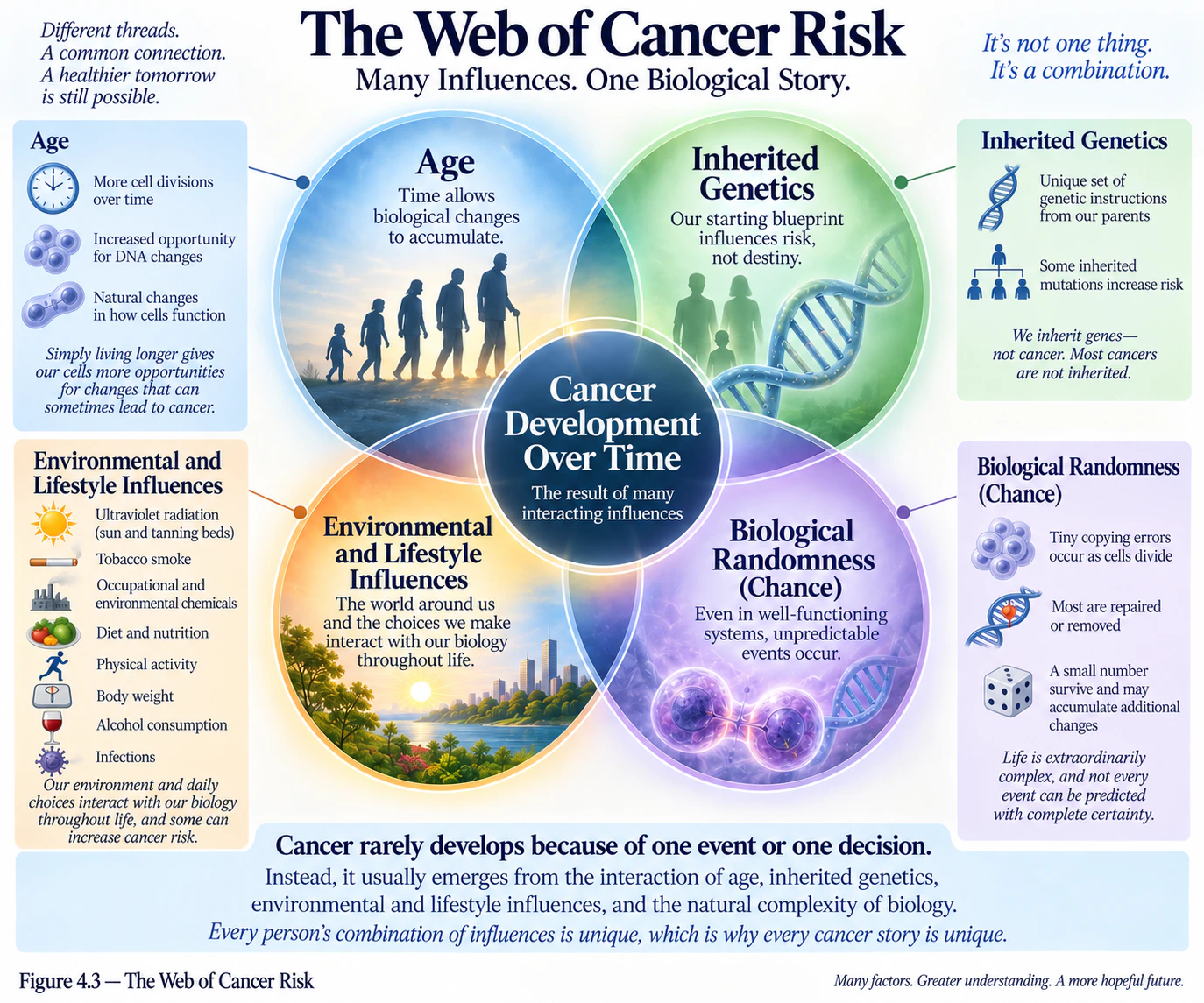
Cancer is rarely the result of one event, one meal, one stressful year, or one imperfect choice. Instead, it usually develops through the interaction of many influences acting over decades. Some of those influences are inherited. Some develop as we age. Some come from the environment around us or the choices we make throughout life. Others remain beyond our current understanding.
This article is not about assigning blame. It is about replacing fear with understanding. By the end, you'll understand why scientists now believe cancer is one of the most biologically complex diseases we know—and why discovering that complexity can replace guilt with perspective, uncertainty with knowledge, and fear with hope.
Cancer Rarely Has One Cause
If you've ever searched the internet for the cause of cancer, you've probably found dozens of confident answers. Some articles blame sugar. Others point to stress. Some focus on environmental toxins. Others say inflammation is the driving force. Still others suggest genetics determines everything.
The reality is both simpler and far more complex. None of these explanations tells the whole story. Cancer almost never develops because of one isolated event. Instead, it usually emerges through the gradual interaction of many biological influences acting over many years—often over decades.
Imagine standing before a beautiful tapestry. From a distance, it appears to be one seamless image. Step closer, however, and you'll discover it is woven from thousands of individual threads. No single thread creates the picture. Each contributes to the whole.
Cancer develops in much the same way. Our age, inherited genes, environment, lifestyle choices, immune system, and countless biological processes all interact throughout life. Some influences increase risk only slightly. Others have a greater impact. Some can be changed. Others cannot. Together, they shape a biological story that is unique to each of us.
This understanding is actually good news. It reminds us that cancer is rarely the result of one meal, one stressful year, one environmental exposure, or one imperfect decision. The human body is far too complex for such simple explanations.
Instead of asking, "What caused my cancer?", scientists are increasingly asking a different question: "What combination of factors gradually increased this person's risk over time?" That shift in thinking changes everything. It moves us away from blame and toward understanding. And understanding is the first step toward replacing fear with perspective.
The goal is not to find one thread to blame for the tapestry. The goal is to appreciate how all of the threads weave together to create the complete picture.
Risk Is Not the Same as Cause
One of the biggest misunderstandings about cancer is confusing risk with cause. In everyday conversation, we often use those words as if they mean the same thing. In medicine, they are very different.
A cause directly produces an outcome. A risk factor, on the other hand, simply changes the likelihood that something might happen. It increases or decreases the odds, but it cannot predict the future with certainty.
Imagine standing outside on a cloudy afternoon. Carrying an umbrella does not cause it to rain, and leaving the umbrella at home does not prevent the rain. The umbrella simply prepares you for the possibility of changing weather.
Cancer risk factors work much the same way.
Smoking increases the risk of lung cancer, but not every smoker develops the disease. Likewise, a person who has never smoked can still develop lung cancer. The same is true for many other risk factors, including age, inherited genes, diet, obesity, alcohol use, physical inactivity, and environmental exposures. They all influence risk, but none can determine an individual's future with absolute certainty.
This is why scientists rarely ask, "What caused this person's cancer?"Instead, they ask, "What combination of factors increased this person's risk over a lifetime?" That distinction is more than scientific—it is deeply personal.
Understanding risk helps us move beyond blame. It reminds us that a cancer diagnosis is rarely the result of one decision or one mistake. Instead, it reflects the complex interaction of biology, environment, lifestyle, and time.
Recognizing that difference doesn't answer every question, but it does replace guilt with perspective. And perspective is often the first step toward hope.
Your Body Is Working for You
After reading about cancer risk factors, it's easy to feel as though our bodies are constantly under attack. We hear about pollution, ultraviolet radiation, processed foods, chemicals, infections, and genetic mutations, and it can begin to feel as though developing cancer is inevitable.
Nothing could be further from the truth. The remarkable reality is that your body is working for you every moment of every day. Billions of cells divide throughout your lifetime, faithfully copying your DNA with astonishing accuracy. When small mistakes occur—as they occasionally do—your cells are equipped with sophisticated repair systems that identify and correct many of them before they can cause harm.
If the damage cannot be repaired, many cells are programmed to destroy themselves rather than pass those changes on. At the same time, your immune system constantly patrols your body, recognizing and removing countless abnormal cells long before they ever become dangerous.
Your liver helps neutralize and eliminate potentially harmful substances. Your kidneys filter waste from your blood. Even your skin serves as an extraordinary protective barrier against the outside world. These defenses are not occasional. They are continuous.
Your daily habits can help support these remarkable protective systems. Eating a nutritious diet, staying physically active, maintaining a healthy weight, getting adequate sleep, avoiding tobacco, and limiting excessive alcohol consumption all contribute to an internal environment that allows your body to function at its best.
None of these choices can guarantee that cancer will never develop. But they do strengthen the very systems that have been protecting you since the day you were born.
Perhaps the most encouraging truth is this: cancer is not evidence that your body failed. It is evidence that, after years—or often decades—of extraordinary protection, a small number of abnormal cells eventually found a way to escape defenses that had been working successfully all along.
Understanding that changes the conversation. Instead of seeing your body as the enemy, you begin to appreciate it as your greatest ally.
Conclusion
Let's return to the question that brought us here:
Why do some people develop cancer while others don't?
After everything we've explored, you can probably see why there is rarely a simple answer.
Cancer is not usually the result of one meal, one stressful year, one inherited gene, or one environmental exposure. Instead, it develops through the interaction of many influences that unfold over a lifetime. Age, genetics, environmental and lifestyle factors, and the natural complexity of biology all play a role. Each person's combination of these influences is unique, which is why every cancer story is unique.
Perhaps the most important lesson is this:
Understanding risk is not about assigning blame.
Many people spend months—or even years—searching for one decision they wish they could undo. In most cases, that search leads nowhere because there is no single event to find. Cancer is one of the most complex diseases in medicine, and reducing it to one cause oversimplifies both the science and the human experience.
The encouraging news is that while we cannot change our age or the genes we inherited, we are not powerless. Every healthy meal, every walk, every good night's sleep, every decision to avoid tobacco, and every effort to care for our physical and emotional well-being supports the remarkable protective systems within our bodies. None of these choices offers a guarantee, but together they represent a meaningful investment in long-term health.
So perhaps the better question is no longer,
"Why me?"
Perhaps it is,
"What can I do today to support my health moving forward?"
That question shifts our focus from the past to the future—from searching for blame to embracing possibility. Knowledge cannot change yesterday. But it can change how we move forward. And sometimes, replacing fear with understanding is the first step toward hope.